
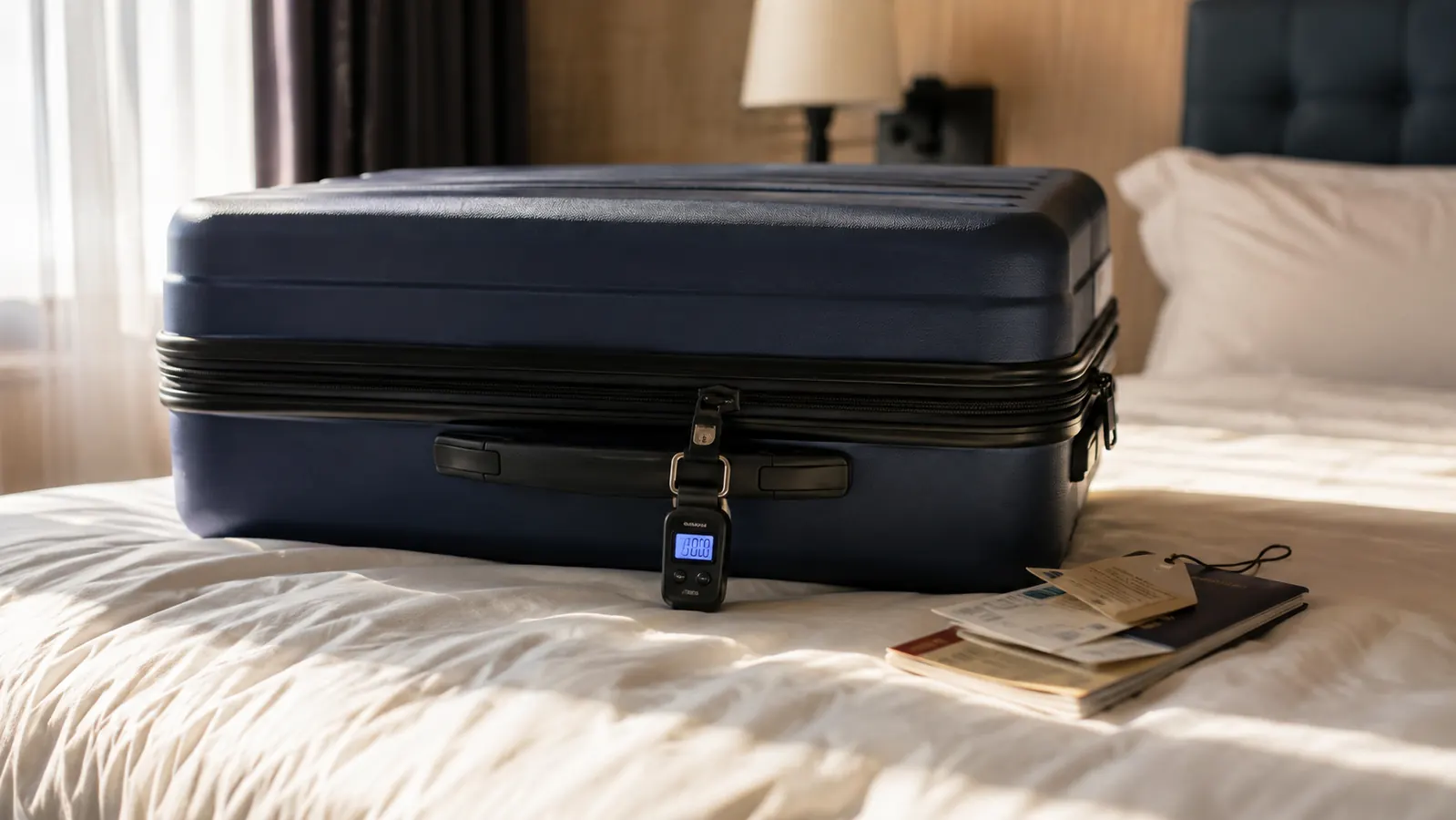
I hit the forty nine pound wall twice in one year before I finally bought a luggage scale. The first time it was my sister Colleen's suitcase, stuffed with a week of clothes, three pairs of shoes and two jars of preserves for our mother. I watched the airline agent slide it onto the little platform, stare, and hold up three fingers, one toward the scale and one toward the counter. Colleen paid a steep check bag fee to check what should have been a free bag, then spent ten minutes in a public aisle pulling out shoes and shoving them into her tote. We repacked the loose shoes into a shopping tote in the middle of the terminal, and as she zipped her case shut I told her I was going to buy an Etekcity Luggage Scale before my own next trip.
Then it was my turn, six months later, on the way back from visiting my daughter in Denver. Same routine, same scale, same fee at the counter, and the same miserable little scene in the aisle. Two fees in two trips, and not one ounce of any of it bought anything I got to keep. I swore I was done guessing, and the minute I got home I ordered the Etekcity Luggage Scale and told myself it was either becoming a permanent habit or joining the drawer of travel gadgets that look great in the listing and never leave the house.
That was nine months ago. Since then I have carried the scale with me on eleven different trips: a long haul to see my brother in Cornwall, two weeks in Italy where my own checked bag refused to behave, three weekend hops to help my mother sort her house, and enough family visits that I have lost count. This is the honest, long term account of what it actually did, how accurate it proved to be, where it let me down, and whether it ever earned back its place in my bag.
The Quick Verdict
The Etekcity Luggage Scale does the one job a luggage scale has to do, weigh your bag before the airline does, and it does it without fuss. In nine months and eleven trips it held within about half a pound of my bathroom scale on the cross check I did, which is all the margin I need to live under a strict limit. It is small, light, and the hook and strap setup never pinched a finger once. My real complaints are small: the buttons sit proud enough that my house keys have switched one on in my purse, and the display is dimmer than I would like in a dark hallway at dawn. For the space it takes in one pocket, it had already more than earned its keep by month two.
Amazon Check Today's Price →Stop Guessing and Let the Scale Do the Math
The repeated overweight fee I paid is that same fee every time, and it would have more than covered this scale on a single occurrence. If you check a bag more than a couple of times a year, this is the one travel gadget that actually hands real money back instead of taking it.
Amazon Check Today's Price on Amazon →If this is your first time reading about a luggage scale, one quick idea before the details. This is not a luxury item, it is a small insurance policy you pack inside your own bag. The check in desk is the only place in the world you do not want to find out what your suitcase weighs. Everywhere else, in your kitchen the night before, is exactly where you want to find out. Hold that thought, because it is the entire reason I have not paid an overweight fee since I started using it.
How I've Used It on Eleven Trips
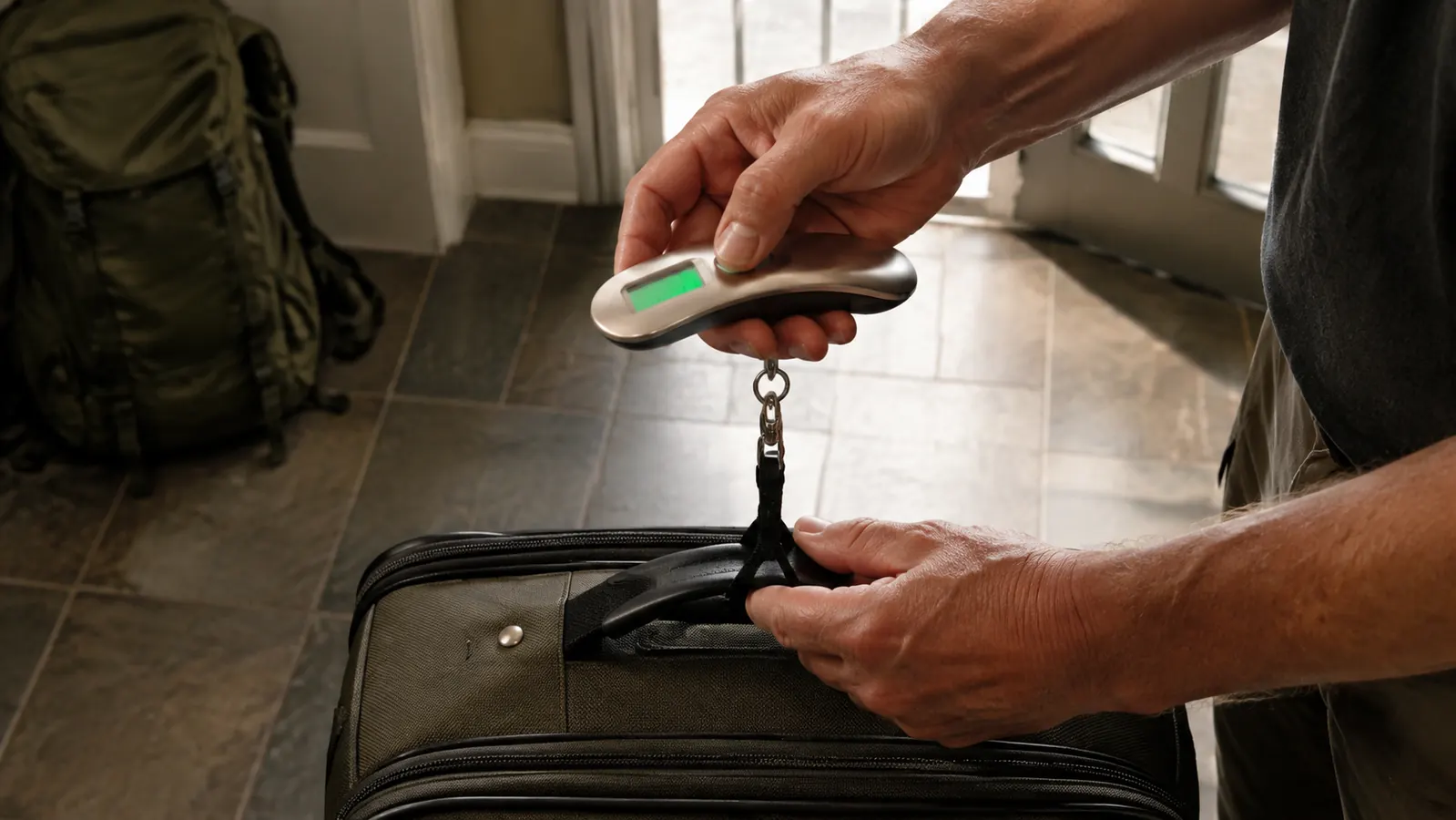
The scale works the way you hope it will. You open the carry case, clip the top strap over the suitcase handle, lift the whole bag off the floor with the little grip on the scale, and wait a few seconds for the number to settle. I pack the same way every trip now: out come the packing cubes, in go the clothes, and once the bag is fully closed I set it flat on the floor, hook the strap over the front handle, and lift until it comes an inch off the ground. The operation takes less than a minute and it is the last thing I do before starting the car.
The first time I did it at home the display read 37.2 and I did not believe it, because the bag looked heavier than that from the floor. So I set it down and lifted again, 37.4. I shifted the hook, lifted a third time, and got 37.1 again. The number held steady across three tries, which told me more than the exact figure did: it is repeatable, so I can trust the trend even if I squint at this last decimal. A number that does not jump around when you lift it twice is a number you can plan under.
Then came the test that actually mattered, because I am naturally skeptical about anything with a chip in it. I carried the scale to my bathroom scale, weighed myself, set it aside, and then weighed myself again hefting the packed bag. The difference between the two bath readings came out within half a pound of what the Etekcity scale drew by itself. When two separate devices agree that closely, and one of them is wobbling against a dresser, that is close enough for me to plan my packing under. It was not a laboratory test, it was a real cross check, and it is the reason I trust it.
So the habit is simple and I kept it for the better part of a year. The checked bag gets weighed the night before every departure, and again the morning of, because I am a person who adds the last book and the last pair of socks at the last second. The carry on gets weighed less often, maybe once a flight, because to me it is a check on my own optimism rather than the last word. And every time the number reads safely under the printed limit, I feel the tension of the whole trip drop by a notch.
The day it all became a permanent habit was a routine drive to my mother's, not even a flight. I had packed a rental car bag on a whim, and out of habit I hooked the scale to the front handle before pulling away. It read an honest weight and I laughed, because there is no reason a bag I load into a sedan needs to stay under any airline number. But doing it without thinking, the way I check for my keys and my phone, is what told me the Etekcity had made it past the honeymoon stage and into the real rotation.
One more habit worth sharing because it saved me a re pack: I weigh the bag twice before I trust the first lift. The very first time I drove to the airport confident of an under limit weight on my scale and the airline's belt read a little over, which is a classic soft floor scenario. Now I put the bag on the hardest surface in the room, the kitchen tile, and take two readings that agree before I pack around them. That routine costs me ninety seconds and it has not let me down since.
What the Reading Actually Is
Here is the honest part. The Etekcity Luggage Scale does not weigh to the ounce, and it is not meant to. It reads in kilograms out of the box, or in pounds if you press the unit toggle, and the number settles over a couple of seconds of steady lift. The readings I got were stable and consistent, but I would not build a packing decision on the last one tenth of a pound, and no one shipping a bag should. Real packing decisions live two or three full pounds below the limit, not in the last decimal.
Where people get let down is expecting exact precision and then panicking when they see a reading near the limit and the airline quotes a slightly different number. My advice after a year is to build in a cushion on purpose. I want my at home reading to land noticeably under the printed number so that at the airport, after the drive and my last minute reading, I am still comfortable. That cushion is a habit I formed on the third trip, and it is the single smartest packing rule I have picked up from this whole exercise.
It only matters if your bag reads over by not by much, but if it does, set it down, walk away, come back, and weigh it once more on a hard floor. A bag sitting on a soft rug can read higher than the same bag on a tile floor. On my travels I have weighed the same packed case once on the hotel carpet and once on the bathroom tile, and the floor change shifted enough to matter on a tight bag. Never re pack over a single stretched reading.
The scale earns its whole keep the day you avoid a single overweight fee at that counter, and that is the cheapest insurance a frequent traveler will ever pack. My only rule is to aim a safe cushion under the limit, then trust the phone.
If it matters, I keep a little slip of paper in the suitcase lid with the working numbers written in pencil, 37.2, 38.1, 36.9, ever since this one. You would be surprised how useful a record of your own packing turns out to be when you finally buy that travel iron or decide the hairdryer stays home. The scale got me into that habit, because it turns weight from a feeling into a bigger number you can write down.
The Details That Actually Matter
The strap across the top is the part that does the real work, because it is what wraps around the bag handle. It is a wide, grippy band that holds the bag without binding my hand the way the rigid plastic hook on a bargain scale does. I have used it on a soft sided duffel, on a hard shell suitcase with a thinner top handle, and on a rolling backpack. On the duffel it is a joyful one handed lift. On the smooth shell it grips a little less, so I center it and pull slow and careful, but it holds.
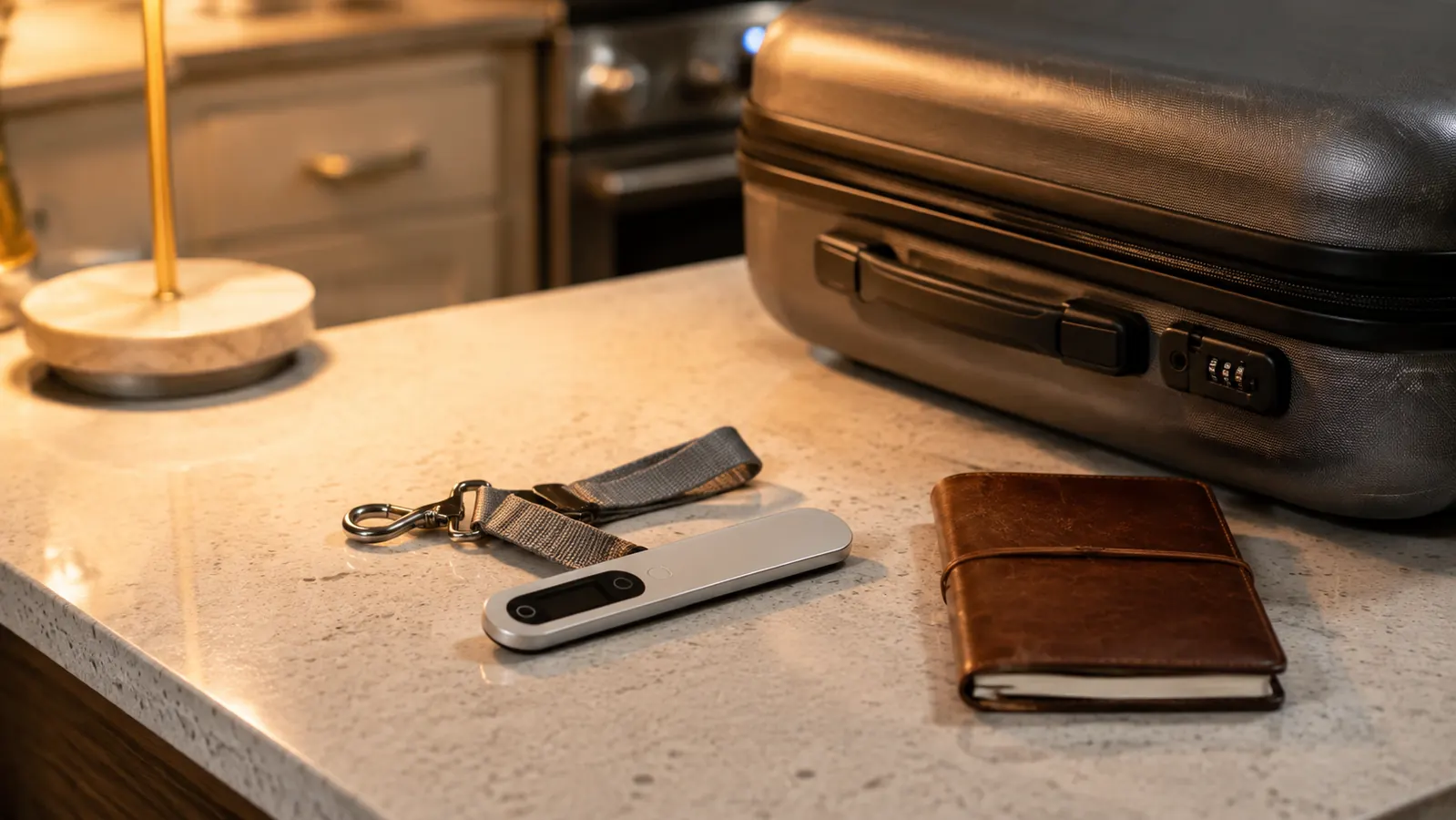
The Etekcity is about the size of two stacked cards and weighs almost nothing, two things that matter to me because I pack light and every ounce counts. Mine rides in the front pocket of my travel bag and I stop noticing it until I need it. It runs on a small coin battery, and in nine months it has not needed a single change. There is a low power symbol on the face, and I have yet to see it.
This is also where I think about the alternatives, because I have packed beside people with the old mechanical spring scale that has a wiggly dial. Those read like a guess with a needle, and the number wanders as the spring settles. And I have seen the premium smart scale that pairs to a phone and charges by cable, a beautiful object but buy a lot of extra parts to drag through security for the same number in the end. If you want to see how this Etekcity Luggage Scale wraps around a bigger set, I compare them honestly in a separate article.
Where It Falls Short
I would be lying if I said the Etekcity Luggage Scale is perfect, and after a year of carrying it I have landed on three honest gripes. The first is the buttons. They are small bump switches on the front that toggle between units and power, and they are small enough that my house keys pressed one on me while the scale was tucked in my purse. Not a calamity, solved with a pouch, but I should not need a pouch for a gadget built to live in a bag.
The second is the screen. It is a compact readout, perfectly legible in a bright kitchen or a sunny lobby, but in a dark entryway at five in the morning I have sometimes had to cup a hand over it to read the number. It never mattered at an airport in daylight, but it caught me a couple of times just before dawn. It could be brighter, but at the price this is a small ask.
The third is a wish rather than a defect: an auto hold on the very last reading. The scale holds the number while you are lifting, but the instant you lower the bag to rest it returns to zero. So the rhythm is read then set down, read then set down, which I do every trip anyway but which I learned the hard way on my first trip when I put the bag down a few seconds too soon and lost the number. A small extra bit of patience fixes it, once you know the rhythm.
What I Liked
- Accurate and repeatable, within about half a pound of a separate bathroom scale on a real cross check
- Small and light enough to ride a carry on pocket unnoticed
- The band handled a hard shell, a duffel and a backpack on the same trip
- A full year in the bottom of my travel bag without quitting
- No battery change in nine months of steady use
- The hook and band design never pinched my fingers during a lift
Where It Falls Short
- Buttons sit proud enough that a key or zipper can press them in a packed pocket
- The display is on the small side and dim in a dark hotel hall at dawn
- Smooth hard shell handles grab a bit less than a fabric duffel, so you center it and pull slow
- No auto hold on the last reading, so you note it down before you set the bag down
- You are lifting the full weight of the bag with your own grip
Who This Is For
If you check a bag more than twice a year, and you have ever felt your heart sink while the agent slid a fee across the counter, this scale is for you. In my case it did not take many times at all before it covered its own keep. The traveler who packs heavy for family visits, who heads home with soaps and a few jars, is exactly the person this gadget repays. If you routinely pack right up to the edge of a checked limit and then gamble on the scale at the desk, this is the tool that ends the gamble.
Who Should Skip It
If you are a strict carry on traveler who checks a bag once in a blue moon or never, you can spend that same small amount on something you actually prize, and this becomes another item in the drawer. And if you fly once a year with a bag you pack the same way and you already know its weight, you may not need telling. But I have learned the number you remember quietly goes up each trip, and I would rather find that out at home while I can still do something about it, than at the counter where the answer is a fee and an open suitcase in the aisle. That is the line that separates who needs one and who gets along fine.
Put an End to Check-In Surprises Forever
I have not paid a single overweight fee in nine months because the scale rides in the belly of my bag. Today's price reads like a rounding error next to what it saves you, and if you fly with a checked bag it is the cheapest insurance on any packing list.
Amazon Check Today's Price on Amazon →